Updated 13 November 2026
Photography business marketing works when it runs as one system: ads that bring the right people to one offer, a CRM that replies within minutes, email and SMS that keep past clients warm, a Google Business Profile people trust, and booking pages built to convert. Run together, they keep a studio booked without you chasing every lead.
This is for owners of established family, pet, kids, newborn and boudoir studios who have tried ads, seen the leads trickle away, and want marketing that holds. It is a systems problem, not a headline problem.
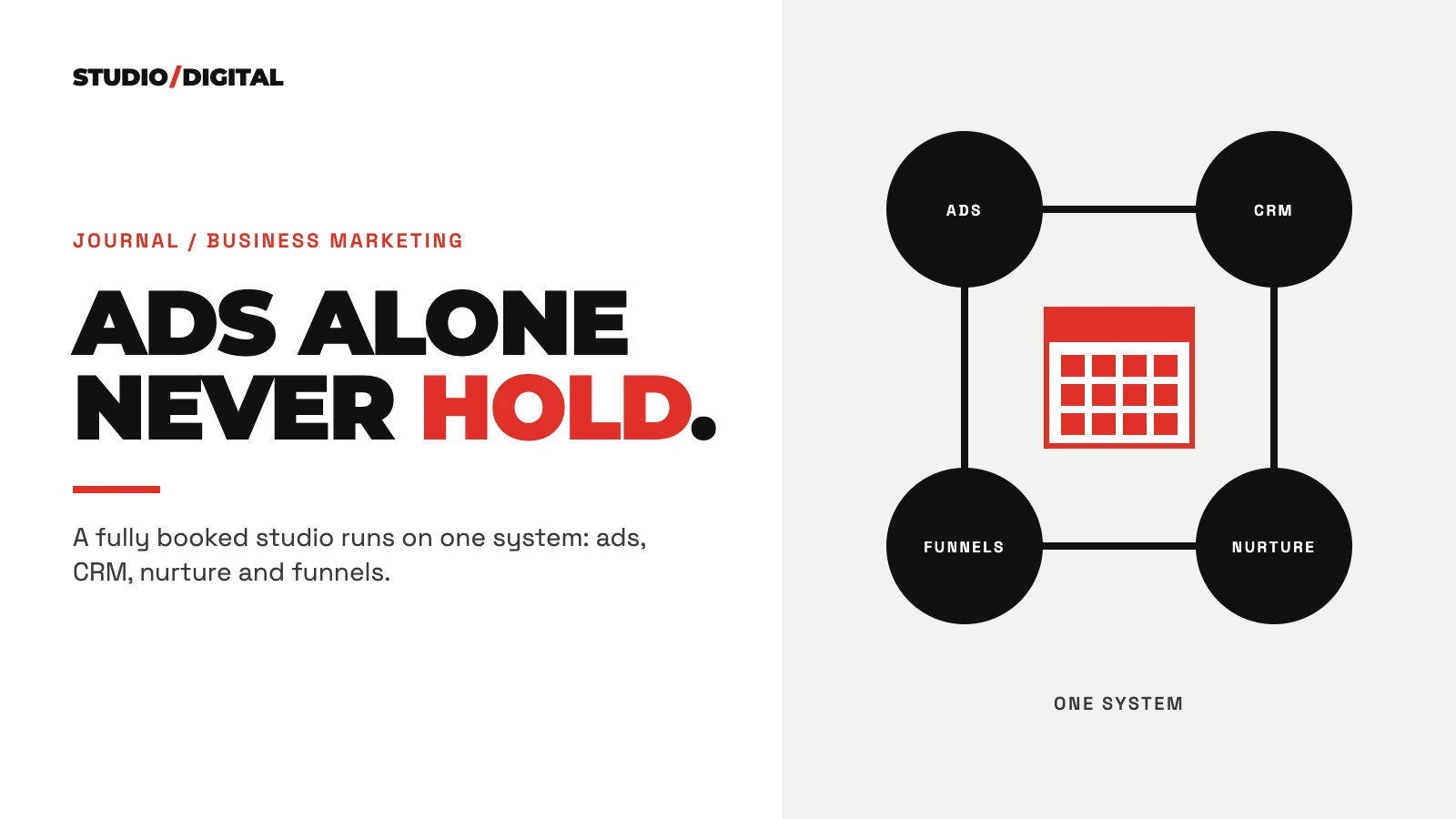
Why ads alone never hold.
An ad gets attention. What happens after the click decides whether that becomes a booked session. If nobody replies within minutes, nothing keeps the conversation warm and the booking page asks too much, the lead goes cold however good the ad was. Studios that judge marketing by the ads alone are judging the whole department by one quarter of it.
The four parts of a real marketing department.
- Meta adsBring the right local people to one offer.
- CRM and automationCatch every inquiry and reply in minutes.
- Email and SMS nurtureKeep past clients and old inquiries warm all year.
- Funnels and booking pagesTurn the interest into a booked session.
Each part hands the lead to the next. Pull one out and the others look worse than they are.
Here is what each part asks of you in time and money, and the number that shows whether it is working:
| Part | Your time, if you run it yourself | The money it needs | Judge it on |
|---|---|---|---|
| Meta ads | Two to four hours a week: new creative, tests, budget checks | Ad spend, set from the sessions you need. A lead cost a median $10.01 across 10 US portrait studio businesses we work with | Cost per booked session |
| CRM and automation | A few days to build, then about an hour a week | A monthly CRM subscription | Reply time, and how many inquiries get an answer |
| Email and SMS nurture | Two to four hours a month to write and schedule | Email is usually inside the CRM; texts are charged per message | Sessions booked by past clients and old inquiries |
| Funnels and booking pages | A day or two per offer, then a seasonal review | Usually the website or page builder you already pay for | Booking rate from each page |
Speed to lead decides who books.
A family or a pet owner who fills in your form is comparing you with whoever replies first. A reply from someone checking their phone between sessions is already behind. Automation does not replace the personal touch; it makes sure the personal touch arrives in time.
- Minute 0 to 5A text and an email, sent automatically
- Day 1A call or a voice note from the studio
- Day 3A session example from their niche
- Day 7What is included and how to book
- Day 14A short last check-in
A starting rhythm, not a rule. The CRM guide shows what the software has to do to run it. We recommend Allio, the CRM built for portrait studios.
Your database is worth more than your ad budget.
Past clients and people who inquired but never booked already raised their hand once. A steady rhythm of email and text, a seasonal offer and a message timed to a birthday or a new puppy brings some of them back without paying for reach again, as long as the emails reach the inbox (we recommend Warmy to keep them out of spam and Promotions). Run your own numbers:
Database value calculator
What your past clients are worth this year.
Three numbers from your own records. The examples below are placeholders; change them to yours.
Enter numbers of zero or more, with the rebook share at 100% or less.
Past clients x rebook share x average sale. It counts repeat sessions only, not referrals, so it understates what the list is worth.
The email marketing guide covers what to send and how often.
Google Business Profile: the listing buyers check.
A referral rarely books straight away. Most people search the studio name first, and your Google Business Profile is what they see: reviews, photos, hours and a way to book. It also decides whether you appear when someone searches for a studio like yours nearby.

- The most specific categoryPortrait studio or the closest fit as the main category, with your other niches added as secondary ones.
- Reviews that keep arrivingAsk at the ordering appointment, then text the review link the same day. Reply to every one.
- Real session photosAdd new ones regularly, with permission, so the profile looks open and busy.
- A link to bookPoint the website button at your booking page, not only your homepage.
The SEO for photographers guide has a twelve-question score for your profile and website.
Family and pet studios need work that speaks their world.
Generic marketing reads as generic. A parent booking a family session and an owner booking a furbaby session want different things, worry about different things and respond to different photos. Creative, offers and follow-up built around session fees, in-person ordering and wall portraits for one niche beat anything made for photographers in general. Go deeper with our guides to family photography marketing, pet photography marketing and boudoir photography marketing.
What you can start this month.
None of this needs a bigger ad budget. It needs the parts around the ad to hold, which is the idea behind a full marketing department rather than one vendor doing one job. See how the parts fit together on our services page, or grade your own mix with the marketing mix grade. Five things to do first:
Been burned before and not ready to hand anyone the keys? Under the Hood is a fixed-price audit with no retainer attached, and you keep the report either way.
Questions studio owners ask.
How do I market my photography business?
Run it as one system rather than a list of tactics. Pick a niche and one clear offer, put ads or search in front of the right people, reply to every inquiry within minutes, follow up by text and email for at least two weeks, and send the offer to a page built for it. Then keep in touch with past clients, because they book again and refer friends.
What are the 5 key marketing strategies?
For a portrait studio: ads that lead to one offer, fast follow-up through a CRM, email and SMS to past clients and old inquiries, a Google Business Profile with steady reviews, and a booking page made for each offer. Each one feeds the next, so a gap in one makes the others look weaker than they are.
What is the 80/20 rule in photography marketing?
It is the Pareto principle applied to the business: a small share of your clients, channels and offers tends to bring most of your bookings and sales. It is a rule of thumb, not a law. Use your own CRM to find your best channel and your best past clients, and give them most of your marketing time before adding a new platform.
Does a photography studio need a Google Business Profile?
Yes. People who hear about your studio from a friend often search your name before they inquire, and the profile is what they see first: your reviews, photos, hours and a link to book. Choose the most specific category, ask every client for a review and add real session photos regularly.