
Is Instagram still worth it for photographers? Yes, for a local portrait studio, if you run it as a booking tool rather than a portfolio. Name your niche and city in your bio, show real clients and finished wall art, reply to messages the same day, and count enquiries, not followers. Pair it with Google Business Profile and email.
If you’ve stared at another studio’s feed wondering how they make it look effortless, while bookings from your own Instagram feel more like a coincidence than a strategy, you’re in exactly the right place. Instagram for photographers isn’t broken. Most studios just use it like a portfolio when it needs to work like a booking tool. Get that shift right and the platform starts pulling its weight alongside the rest of your marketing, instead of eating an hour of your evening for nothing.
Is Instagram for photographers still worth it, or should you give up on it.
Search around and you’ll find plenty of voices arguing that Instagram for photographers is dead, that reach has collapsed, that the algorithm rewards everyone except the account trying to sell something. Some of that is true, for the accounts they’re describing: a photographer posting for other photographers, chasing likes from people who will never book a session. That’s not your account. You’re a local service business with a defined audience in a defined radius, and for that kind of account Instagram still does something almost nothing else does without an ad budget: it lets a stranger see your work, picture themselves in it, and message you before they’ve spoken to anyone else in your studio. The platform hasn’t stopped working. It’s stopped working for people using it the wrong way.
You’ll also see specific posting ratios thrown around, so many curated posts to so many original to so many promotional. Those frameworks were built for someone growing a personal brand from zero followers. You’re not building a personal brand, you’re running a studio people trust the moment they see the work. Borrow the instinct, mostly value, occasionally a direct ask, and ignore the exact numbers. Post your own sessions, not curated content from strangers.
If you want inspiration, follow studios in markets you’ll never compete in, not the ones three towns over. Studying a nearby peer’s feed too closely is how studios end up with a grid that looks like everyone else’s, which defeats the entire purpose. Your point of difference is your own clients, in your own studio, having a real reaction. Nobody else has that.
Why Instagram for photographers works differently than it does for everyone else.
Most businesses have to explain what they sell before anyone cares. You don’t. A portrait studio sells something people can see and feel in a single photo, which means Instagram can do work for you that a plumber or an accountant could only dream of. The catch is that it only works if you stop posting for other photographers and start posting for the parent scrolling at nine at night, picturing her own family on the wall, or the dog owner who has never had a proper photo of the dog who is basically family.
The most common mistake we see is a feed built to impress peers rather than book clients. Gear talk, editing breakdowns, behind the lens shots of you rather than the experience of being photographed. None of that tells a potential client what session day feels like, what the images look like on a real wall, or why they should choose you over doing nothing at all. Insider language like session fee, IPS, and wall portrait means nothing to your followers. What they respond to is joy they can picture for themselves.
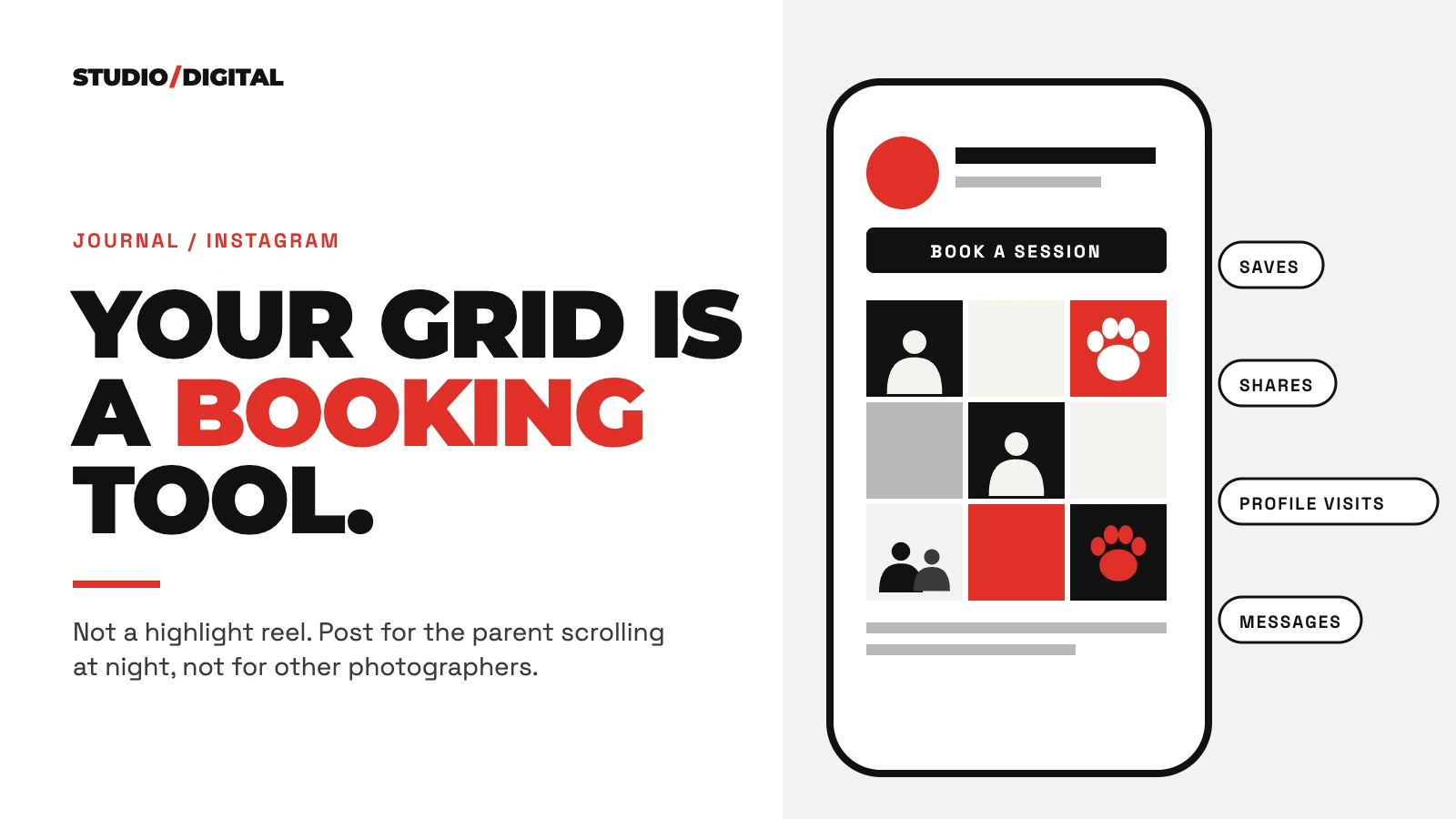
Your bio and grid are a booking tool, not a highlight reel.
Your bio has one job: tell a stranger who you photograph, where, and what to do next, in the three seconds before they decide whether to keep scrolling. Name your niche in plain words. Name your city or region so local clients recognize themselves immediately. Point to one link, not a maze of them. None of that is a revelation, every small business guide says the same thing. What’s different for a studio is the grid underneath it: your first nine images do the job a homepage does for anyone else, so they need to show real sessions, real reactions, and real walls, not gear talk or editing breakdowns that mean something to other photographers and nothing to a parent deciding whether to book.
Run your own account through this before you change anything else.
Speak to families and pets first, because that’s who’s scrolling.
If your studio leans toward family portraits, furbaby sessions, or both, lead with that everywhere: elegant families filling a bright studio, dogs mid session looking genuinely happy, parents laughing rather than posing. Joy has to be real, because people can tell the difference between a styled shoot and a moment that actually happened. If you want a deeper breakdown of what to prioritize for each niche, our guides on family photography marketing and pet photography marketing go further into the specifics. The same instinct applies if your studio also books boudoir or newborn sessions: lead with the emotion of the experience, not the technical craft, and our guides for boudoir photography marketing and newborn photography marketing walk through what that looks like for those audiences.
Stories and reels are where trust gets built.
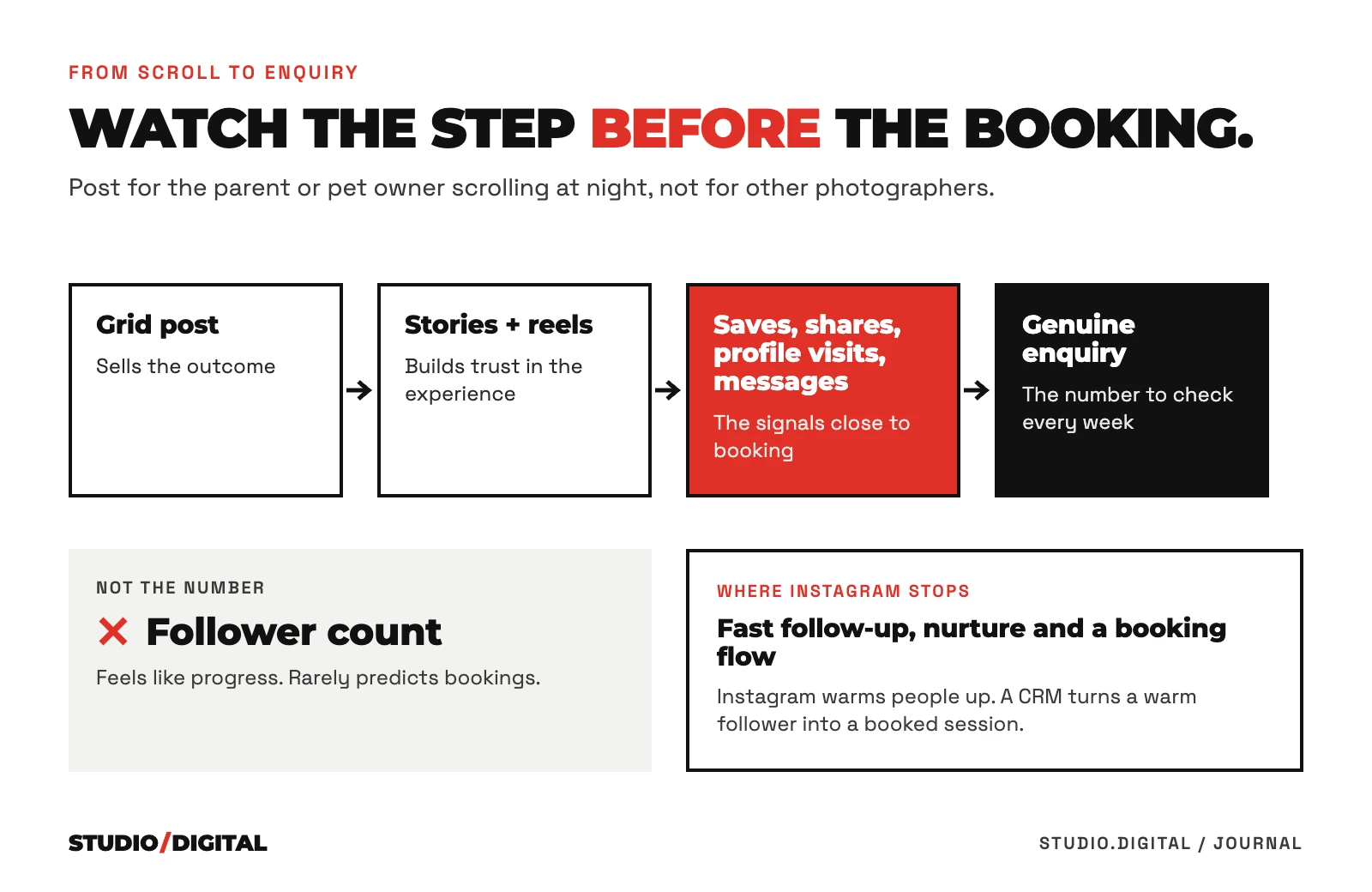
Grid posts sell the outcome, but most of the trust building happens in stories and reels, where people see the experience of getting there. Show the studio itself: the walk in, the setup, the energy of session day. Show the moment a client sees their images for the first time, even from behind them. Walk through what an ordering session actually feels like, because most people have never experienced one, and the mystery is part of what makes them nervous to book in the first place. Consistency beats production value here. A simple video posted every week will outperform one polished reel posted once a quarter.
Stop chasing followers. Watch this number instead.
Follower count feels like progress, but it rarely predicts bookings. What actually matters is how many people move from watching to engaging: saves, shares, profile visits, and direct messages asking a question. Those are the people close to booking. Once a week, check how many genuine enquiries came through Instagram, not how many new followers you gained. That single habit will tell you more about whether your content is working than any vanity metric ever will.
Instagram vs Pinterest, Google Business Profile and email.
Instagram is one channel among several. Each does a different job, and most studios need at least two working together.
| Channel | Best at | Who finds you there | What to measure |
|---|---|---|---|
| Showing the experience and building trust before someone enquires | Followers, and friends of clients who tag you | Enquiries and messages each week | |
| Long-lasting discovery of outfit, styling and wall-art ideas | People planning a session months ahead | Saves and clicks to your site | |
| Google Business Profile | Showing up when someone searches for a photographer near them | People ready to book in your area | Calls, website clicks and direction requests |
| Turning people who already know you into bookings | Past clients and past enquiries | Replies and booked sessions |
The post types that actually book sessions.
Not every post earns its place on a studio feed. If you strip it back, three kinds of content consistently do the work of turning a viewer into an inquiry.
- Behind the session: wardrobe consults, styling choices, how you prepare a family or a nervous dog for the camera. This builds trust before anyone books, because it answers the unspoken question of what actually happens on the day.
- The reveal moment: a client seeing their wall portrait or album for the first time, shared with their permission. This is the single most persuasive thing you can post, because it shows the transformation rather than describing it.
- The world of the studio: the styled sets, the light, the small details that make your space feel considered rather than generic. This is what makes someone picture themselves, or their family, or their dog, inside your studio.
Everything else, the quotes, the trending audio for its own sake, the posts that exist because you felt you had to post something, can be dropped without costing you a single booking.
Stories and DMs are where the booking actually happens.
The feed opens the door. Stories and direct messages are where someone walks through it. Use polls and question stickers to invite a reply, because a reply is a warm lead in a way a like never is. Then the part most studios get wrong: speed. A person who messages you while the feeling is fresh will cool off fast if your reply comes a day later. The studios that book consistently from instagram treat every DM like a phone ringing, and they have a system behind the scenes so a message never sits unanswered overnight. That is not a content tactic, it is a follow-up discipline, and it is one of the reasons a proper marketing setup includes automation as standard rather than an afterthought.
If you want to see what that looks like when it is built properly, our services page walks through how the follow-up side works alongside the content and ads.
Ads still need organic to do its job.
Organic content and paid ads are not competing strategies, they are two ends of the same job. Organic content builds the trust that makes an ad believable when someone sees it. An ad without an organic presence behind it feels like a stranger’s pitch. An organic presence without ads only ever reaches the people already following you. If you are a family studio or a pet photography studio deciding where to put your energy first, build the organic foundation, the reveal posts and behind the session content, before you put a single dollar behind ads. It will make every dollar work harder.
We go deeper on this by niche on our family photography marketing and pet photography marketing pages.
When Instagram alone stops being enough.
Instagram is brilliant at the top of the funnel. It introduces you, builds recognition, and warms people up before they ever fill out an enquiry form. What it can’t do on its own is follow up fast enough, nurture someone who isn’t ready yet, or turn a warm follower into a booked session on a predictable schedule. That’s the gap between studios who post consistently and still feel stuck, and studios who are genuinely fully booked. If paid reach is part of your plan, Instagram ads for photographers covers how paid and organic work together. For the full picture of what sits alongside Instagram in a studio’s marketing, our marketing for photographers page and our services page both walk through it. If you’re the type who wants proof before you trust anyone with your marketing, Under the Hood is built exactly for that: a fixed price audit you keep either way, no retainer attached. Don’t trust us yet? Good, that’s what it’s for.
You can read more about why we only work with portrait studios on our About page, or see what studio owners like you have said on Wall of Love. More on the journal at /journal/.
Apply NowInstagram for photographers: common questions.
How do photographers grow on Instagram in 2026?
Post for the people who book, not for other photographers. Your bio should say who you photograph, where, and give one link. Your first nine images should be real sessions, real reactions and portraits on real walls, not gear talk or editing breakdowns. Use stories and reels weekly to show what session day feels like. Then measure enquiries, not followers: once a week, count the genuine enquiries that came through Instagram.
Best Instagram strategy for portrait photographers?
In our view, Instagram works best for a portrait studio as one input to a full system, not the whole strategy. Post three things: behind the session, the reveal moment and the world of your studio. Answer DMs fast. Then make sure there’s follow-up and nurture behind it, because Instagram can fill an inbox and still leave a calendar half empty if nobody follows up. That follow-up system is what Studio Digital builds for studios.
How often should a photographer post on Instagram?
There’s no magic number, and we’d ignore posting ratios built for growing a personal brand. In our view, consistency you can keep matters more than volume: a simple video every week will do more than one polished reel a quarter. Post your own sessions, not curated content from strangers, and drop anything posted just to fill a gap. Then check weekly how many genuine enquiries came through Instagram, because that tells you more than any schedule.
Do Reels help photographers get bookings?
In our view, Reels help a portrait studio build trust, which comes before a booking. Show the studio, the energy of session day and the moment a client first sees their images. A simple video every week beats one polished reel a quarter. On their own, though, Reels don’t book sessions: a fast reply to every enquiry, nurture for people who aren’t ready yet and a clear booking page do that part.
How do photographers turn Instagram followers into clients?
Followers become clients when there’s a clear next step and a fast reply. Make your bio say who you photograph, where, and give one link to book. Use polls and question stickers in stories to invite a reply, because a reply is a warm lead in a way a like never is. Then answer every DM quickly, with a system such as a CRM like Allio, so messages never sit overnight and people who aren’t ready yet keep hearing from you.
Best hashtags for portrait photographers?
We don’t publish a hashtag list, because in our view hashtags are a small lever for a portrait studio. What makes the right person stop scrolling is recognising their own world: their family, their dog, your studio. If you use hashtags, keep them specific to your niche and your city, the way a local client would describe what they want. Put more effort into your bio, your first nine images and how fast you answer DMs.
Should a photographer have a separate business Instagram?
Yes, in our view a studio should have an Instagram account built for the studio, not a personal feed. You’re running a business people trust from the work, so the account should speak to clients: your niche and city in the bio, one link, real sessions and reactions on the grid. Keep personal posts and gear talk elsewhere. A separate studio account also makes it easier to see how many enquiries Instagram actually brings in.