
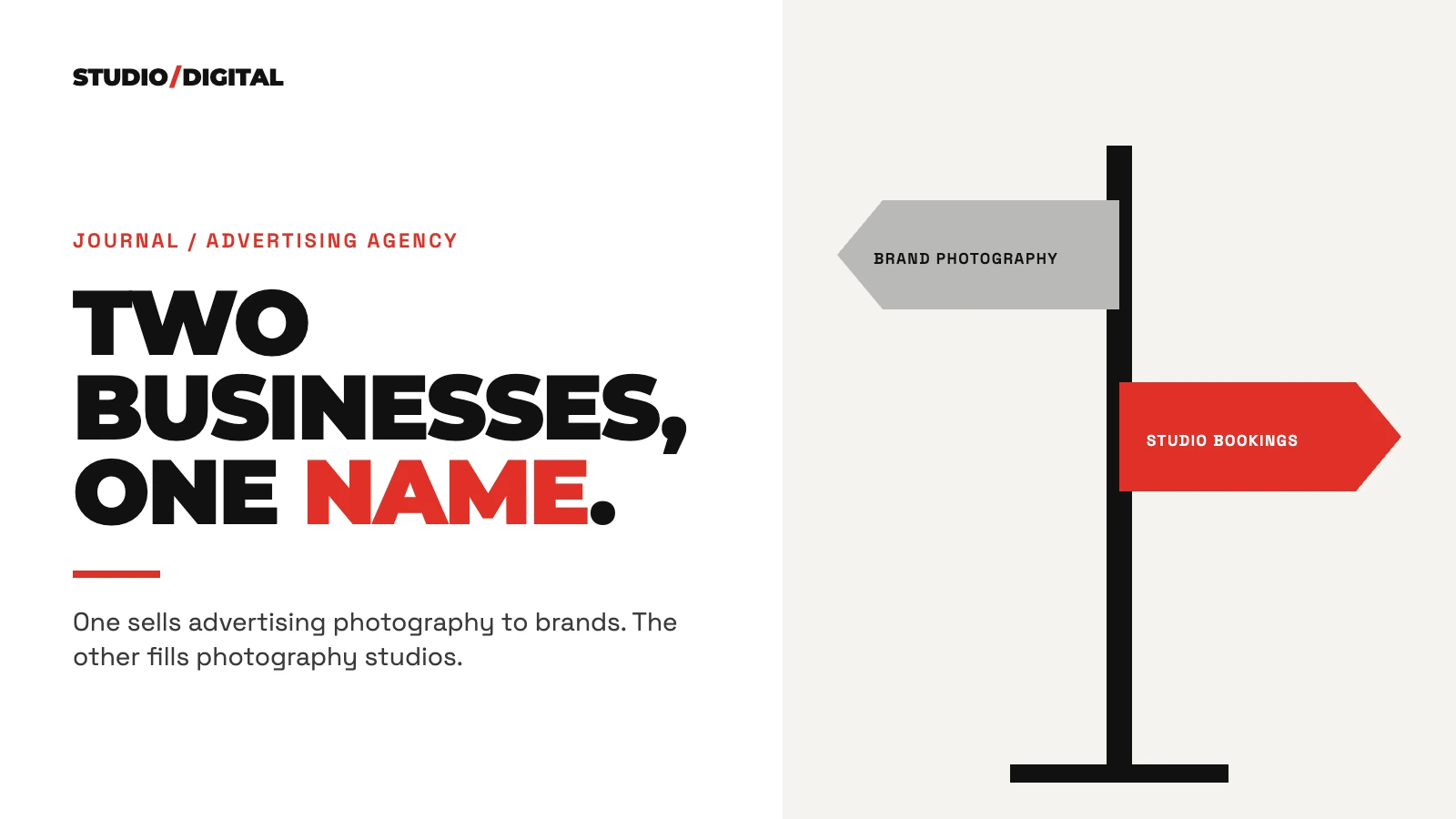
Search for a photography advertising agency and you will land in two unrelated industries at once. One sells advertising photography to brands: images for a campaign, a catalog, a product launch. The other markets photography studios themselves, building the ads, follow up and booking systems that fill a calendar with paying clients. If you own a luxury portrait studio, you need the second kind. This article names that split, answers the questions people actually ask around it, and points you to the specialist built for studios like yours.
“Photography Advertising Agency” Is Two Different Businesses Wearing the Same Name.
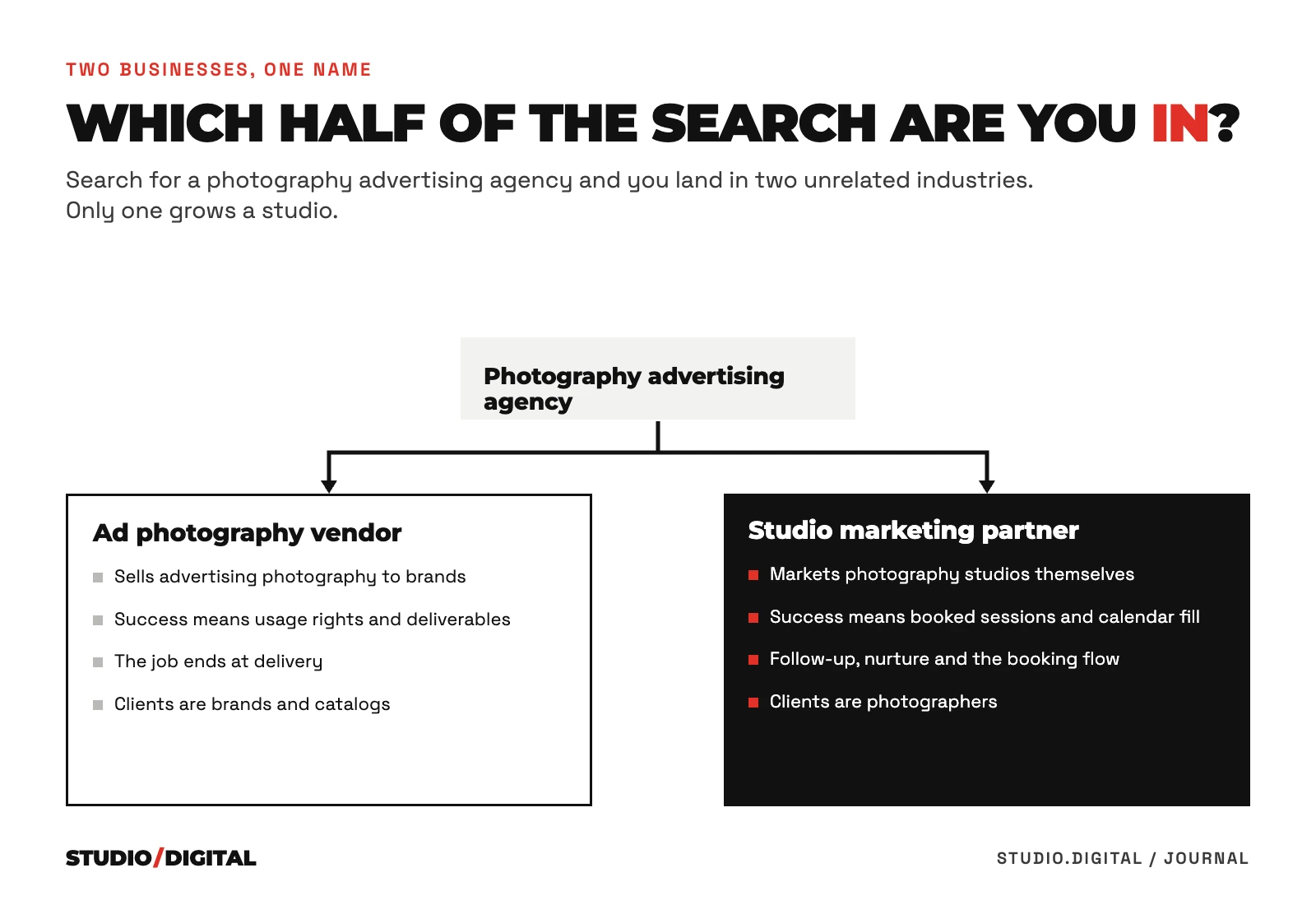
Type the phrase into Google and the results split cleanly into two camps, and both are large, established categories in their own right. The first camp sells advertising photography: agencies and freelancers hired by brands to handle the creative, the media buying and the campaign management behind the images that go into a campaign, a catalog or a product page. The second camp does something completely different. They market photography businesses, running the ads, the customer relationship systems and the follow up that turns interest into booked sessions. Neither side tends to say so out loud, which is why the search results feel scattered no matter which meaning you had in mind. That confusion is rarely named out loud because each business, understandably, only sees its own side of the market. A vendor selling images to brands has no reason to explain the marketing agency side, and a marketing agency for photographers has little reason to explain the stock and commercial supply side. The result is a results page where whichever meaning you did not intend still shows up, uninvited. This piece is written for the second reader: a portrait studio owner who wants more of the right clients walking through the door, not a brand buyer looking to license images.
How Do I Advertise My Photography?.
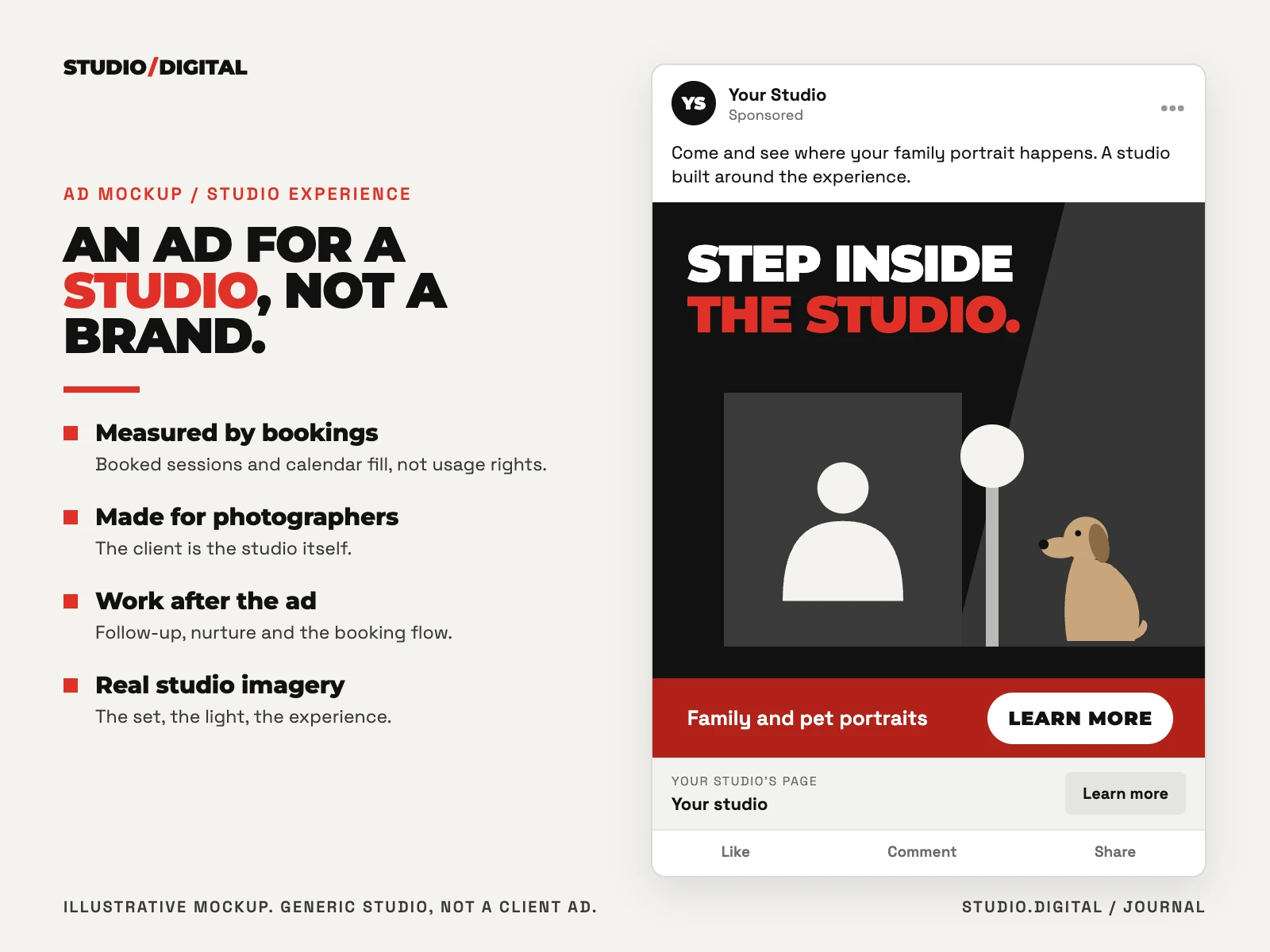
If you are a studio owner, the honest answer has nothing to do with hiring a photo supplier. Advertising a photography business well means building four working parts that talk to each other: paid ads that put your work in front of the right people, a system that follows up on every enquiry before it goes cold, email and SMS that keep past clients warm between sessions, and a booking flow that turns interest into a session on the calendar without friction. Run any one of these alone and results stall. Run all four together and a studio’s calendar starts to fill on its own. For the deeper walkthrough, see how to advertise photography services the right way. If you want a longer list of channels and formats beyond the four pillars, portrait advertising that books sessions and photography advertising that fills your book both go deeper on the advertising piece specifically.
Why an hourly rate is the wrong yardstick for a portrait studio.
This question comes from a different world than luxury portrait work. Hourly rates make sense for photographers who are paid for their time on a shoot: events, commercial jobs, day rate work. A luxury portrait studio does not sell hours. It sells a session fee and the wall portraits, albums and products a client chooses afterward, so an hourly number tells you almost nothing about whether the business is healthy. The studios that do well are not the ones charging the highest rate per hour. They are the ones with a full calendar and a print and product process that turns each session into real revenue. That is a marketing and systems question, not a pricing one.
What the studios that grow past six figures have in common.
There is no honest, verifiable public dataset that answers this precisely, and any figure you see quoted online should be treated with caution. What is true, from the inside, is that the studios crossing into six and seven figures share the same two things: a calendar that stays booked and a system behind it, rather than a founder doing everything by hand. Mike bought a family portrait studio in 2009 and, alongside his wife who ran the camera, grew it to $16 million in sales before building Studio Digital to do the same for other studios. Mike also spent years speaking about this at industry conferences across Europe and the United States, which is a different kind of evidence than a headline income number: direct exposure to what actually separates a thriving studio from one that is coasting. The lesson from that studio was never about working more hours. It was about building the ads, follow up and booking process that keeps a calendar full without depending on the owner’s personal hustle.
Print sales rules of thumb are not a marketing system.
The 20/60/20 rule is a print sales heuristic some studios use to set expectations, not a marketing strategy. The rough idea: a small share of clients at a reveal will spend well above your average, most clients will land close to the average, and a small share will spend at or near the minimum. It is a useful way to think about your product pricing and your in person sales process. It has nothing to do with how a client finds you in the first place, which is where an actual marketing system, not a pricing rule of thumb, does the work.
How to Tell a Studio Marketing Partner From an Ad-Photography Vendor.
A short checklist saves a call with the wrong category of agency.
- Ask what they measure success by. A studio marketing partner talks about booked sessions and calendar fill. An ad-photography vendor talks about image usage rights and campaign deliverables.
- Ask who their other clients are. A vendor lists brands. A studio partner lists photographers.
- Ask what happens after the ad runs. A vendor’s job usually ends at delivery. A studio partner’s job includes the follow up, the nurture and the booking flow that turns a click into a session.
- Ask if their portfolio is product and brand work or photographers’ own studios. If it is retail catalogs and brand campaigns, you are talking to the wrong half of the search results.
The full breakdown lives in how to choose a marketing agency for your portrait studio, and if reputation and press coverage is what you are actually after, that sits with a PR agency for photographers rather than either category above.
What a Real Marketing Department for Portrait Studios Actually Includes.
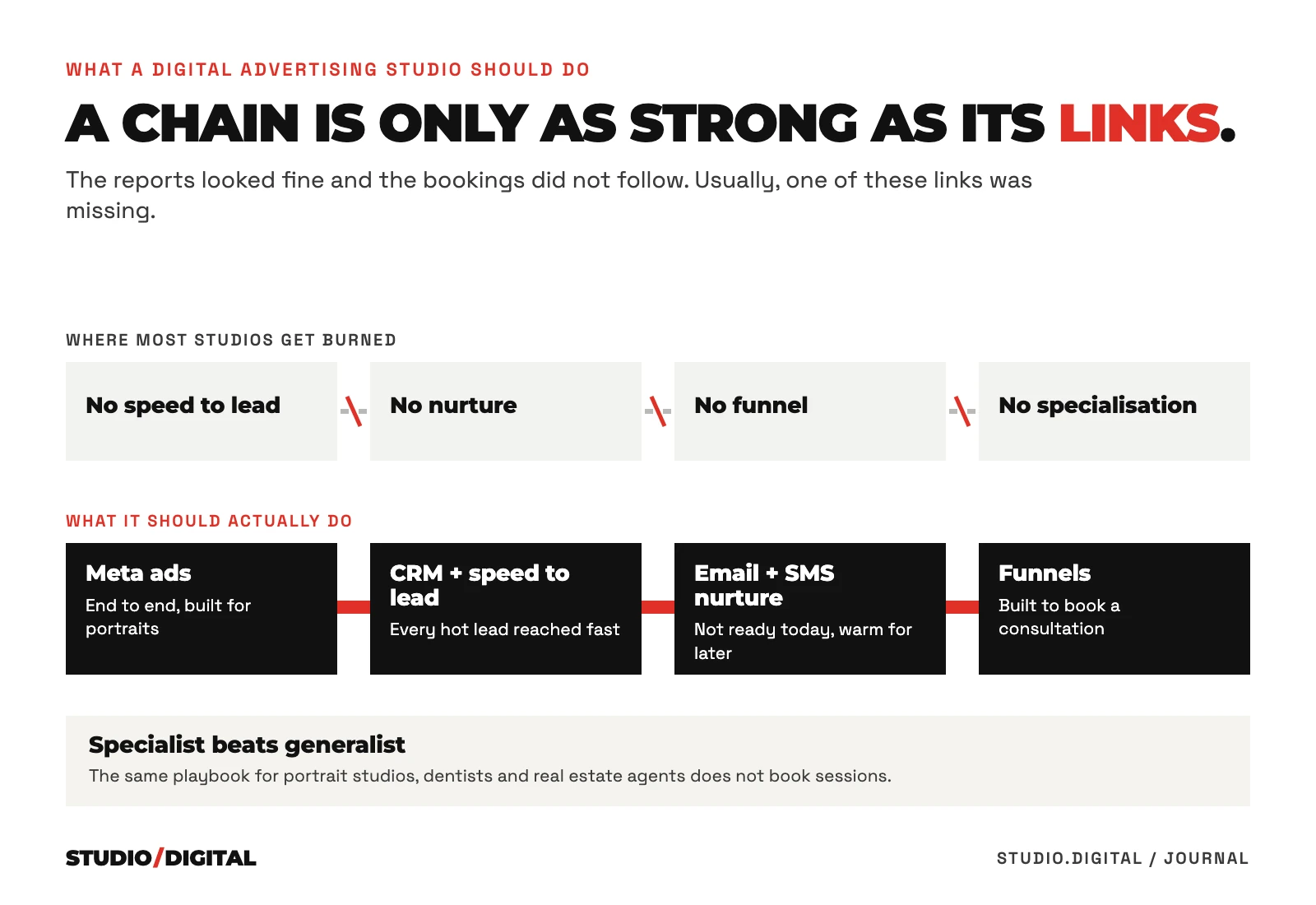
Most of the pages ranking for this phrase describe creative services or full service marketing without saying what that means day to day. For a portrait studio, it means four concrete parts working together. Meta ads: strategy, creative and media buying handled end to end, not a boosted post here and there. A CRM and automation behind it, so a new enquiry gets a fast reply and nothing sits unanswered overnight. Email and SMS nurture, so past clients hear from you between sessions instead of only when you need a quiet month filled. And funnels and landing pages built for booking a session, not a generic contact form. Leave any one of the four out and the others end up carrying more weight than they should. For more on the advertising piece alone, these photography advertising ideas are a reasonable starting point, though the ads only really work once the other three parts are in place.
On pricing: studio marketing agencies do not typically publish retainer rates, and for good reason, the right investment depends on your market, your goals and where your studio is today. You do not put your wall portrait prices in your Instagram bio. A studio marketing partner should not put its retainer in a blog post either. What we can tell you is this: it is built for established studios investing seriously in growth, not for owners shopping for the cheapest option, and the one number we do publish is the fixed price for Under the Hood, the no retainer starting point below.
The Four Things a Digital Advertising Studio Should Actually Do for You.
Running ads is the visible part of the job. It is also the smallest part of what actually gets a studio booked solid. A digital advertising studio worth paying should cover four things, not one: the ad strategy, creative, and media buying itself, a CRM and automation system that follows up with every lead the moment they raise their hand, email and SMS nurture that keeps your database warm between sessions, and funnels and landing pages that turn a click into a booked consultation. Leave any one of those out and the other three end up carrying the whole weight on their own. Most of the disappointment studio owners describe when they talk about past agencies traces back to exactly that gap: strong ads, with no system behind them to catch what the ads produce.
Where Most Studios Get Burned.
The pattern is familiar to anyone who has tried ads before and felt let down. An agency runs the ads, leads trickle in, and then nothing happens with them. No CRM, no speed to lead, no follow up sequence, just a name and a phone number sitting in an inbox somewhere. By the time anyone calls back, the lead has booked with someone else or simply lost interest. The studio owner assumes the ads failed. In reality the ads did their job. The system meant to catch and nurture what the ads produced was never built in the first place. This is why ‘we tried ads and they did not work’ is often true and misleading at the same time.
- No speed to lead. A hot lead sits for hours or days before anyone reaches out.
- No nurture. Leads who are not ready today go cold instead of staying warm for later.
- No funnel. Traffic lands on a generic page instead of one built to book a consultation.
- No specialization. The same playbook used for portrait studios gets used for every other local business on the client roster too.
Any one of these on its own will quietly drain a budget. Together, they are the difference between a studio that is fully booked and one that is still chasing its next client every single month.
Questions Worth Asking Before You Sign Anything.
A short conversation will tell you more than any polished case study. Ask these questions before you commit to anything ongoing, and pay close attention to how specific the answers are.
- Do they work exclusively with portrait photographers, or portraits alongside real estate agents, dentists, and everyone else on their client list.
- What happens the moment someone clicks your ad and does not book on the first call.
- Who owns the follow up: a real CRM and automation system, or a spreadsheet someone checks when they remember to.
- Can they walk you through the exact funnel a lead moves through, step by step, from click to consultation.
- Is there a fixed price way to see how they think and work before you commit to an ongoing retainer.
Vague answers to any of these are the real signal. A studio owner who has been burned before knows to listen for specifics, not confidence.
Why We Only Do Portrait Studios.
Studio Digital only works with portrait photographers. Not brands, not events, not weddings, only portrait studios, because that focus is what turns generic advice into a system that actually fits how a studio makes money. Mike ran bookings, marketing and sales at a family portrait studio for over a decade before building this agency, so the insider vocabulary, session fees, wall portraits, the psychology of an in person sales appointment, is not theory. The focus stays narrow on purpose. Studio Digital works exclusively with portrait photographers, nobody else, which means every recommendation is built for how a portrait studio actually operates rather than adapted from retail, ecommerce or restaurant marketing. Some of the most successful portrait studios in the world, including multi-seven-figure studios, already work this way. The full story of how this agency came out of a real portrait studio covers the rest of it.
Don’t Trust Us Yet? Good..
If you have been burned by an agency or a DIY attempt before, skepticism is the right response, not something to apologize for. That is exactly what Under the Hood exists for: a fixed price audit of your studio’s marketing, no retainer attached, and you keep the report either way. It is built for readers who want proof before they hand their ad budget to anyone again. When you are ready to see the full picture of what a marketing department for portrait studios includes, our marketing for photographers page lays it out, or start with Under the Hood, our photography ads audit, if you want the no trust required version first.
Apply for a spot